
Home gym shed cost in Orange County starts at $19,900 for an 8×10 and $25,300 for a 10×12, with insulated, drywalled and painted walls on a concrete slab or piers. Rubber flooring, electrical and a mini-split are quoted per job, because they depend on your equipment, your panel and how you train.
By Bedrock Sheds | CSLB #1087479 | October 22, 2026
Want the number for your yard? Call (949) 688-2674 and we’ll give you a real range the same day.
A gym is one of the harder rooms we build. It takes dropped weight on the floor, heat in August, and a rack that needs headroom. So the price comes down to three questions: what’s under the floor, what’s on the walls, and how the room stays cool.
How much does a home gym shed cost in Orange County?
A home gym shed from Bedrock costs $19,900 to $25,300 before flooring, power and cooling, depending on size.
| Size | Shell | Insulation, drywall, paint | Total before flooring, power, cooling |
|---|---|---|---|
| 8×10 (80 sq ft) | $15,000 | $4,900 | $19,900 |
| 8×12 (96 sq ft) | $16,000 | $5,800 | $21,800 |
| 10×10 (100 sq ft) | $17,000 | $6,100 | $23,100 |
| 10×12 (120 sq ft) | $18,000 | $7,300 | $25,300 |
The wall finish is fiberglass batt insulation at R-15 in the walls and R-30 in the ceiling, drywall at 5/8 inch on the ceiling and 1/2 inch on the walls taped to a level 4 finish, and two coats of interior paint. Same prices in Orange County and San Diego County, no trip charge. These are starting prices for a level, accessible site, and we confirm the number in writing at the site visit.
Some people skip the drywall and hang plates and bands straight on the framing. That works. Our walls are sheathed in 19/32 inch structural plywood behind the studs, so a wall-mounted plate rack has something solid behind it either way. If you’d rather have vinyl plank in part of the room, all four interior items bought together as our Finished Interior package run $5,350 to $8,000.
Should a gym shed be on a slab or piers?
If you’ll drop heavy weights, build on the slab and put down rubber matting half an inch thick or more.
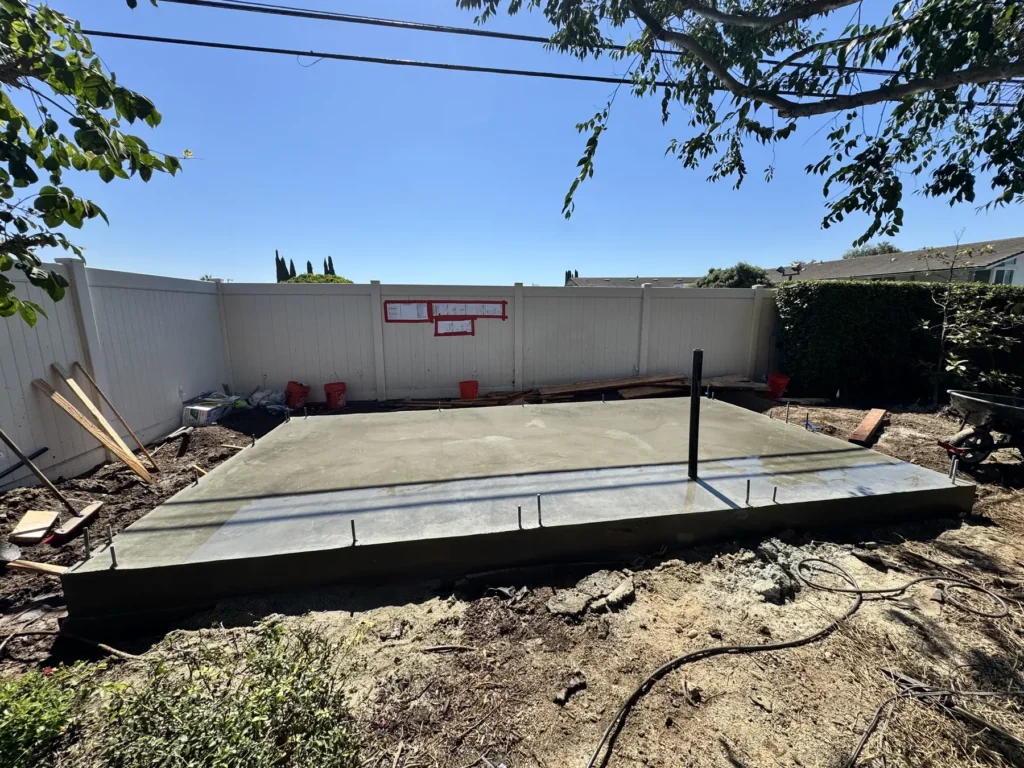
Our slab is 4 inches of 2,500 psi concrete with #4 rebar through the footings and slab, over a 10-mil vapor barrier, 2 inches of compacted sand and 3 inches of gravel. A deadlift dropped on rubber over that goes into the ground.
The pier option is a framed floor: 3/4 inch plywood screwed down over pressure-treated 2×6 joists at 16 inches on center, every joist in a metal hanger at both ends, on 12 inch concrete piers. It’s a stiff floor, and it suits machines, a bench, dumbbells and bodyweight work. It’s still a wood floor, and repeated heavy drops belong on concrete. The slab and the piers cost the same, so for a gym, the slab is the free choice. Piers make sense when the yard slopes too much for a slab.
What flooring goes in a shed gym?
We install 100% rubber mats on most gym builds, at half an inch thick or more where weights get dropped, and you can choose something else if you’d rather.
Rubber flooring is quoted per job, because the thickness and coverage depend on what you lift. The reason it works on our slab is the vapor barrier under the concrete. Rubber holds moisture against whatever it sits on. Over a sealed slab, that’s fine. Tuff Shed’s own care sheet for its Tahoe Series tells owners not to put rubber mats on its floors at all, for exactly that reason.
How tall is the inside of a gym shed?
Interior wall height on our builds runs between 7 and 8 feet, depending on the roof style and the interior finish.
Our standard roof is single pitch, so one wall is taller than the other. That high wall is where the rack, the pull-up bar or the rings go. Drywall on the ceiling takes a little off the top too.
Before you pick a size, stand under something about that height with a broomstick and press it overhead, then jump to a pull-up. If you need more room than that, tell us at the site visit and we’ll look at what the roof can do before anything is ordered.
How do you keep a gym shed cool?
Insulation does most of the work, and a mini-split does the rest.
We install mini-splits. They’re the right fit for a room this size: one wall unit, no ducts, and they run efficiently in a small, insulated space. A mini-split is quoted per job, and it needs its own electrical circuit, which brings a permit with it.
If you train early or late and mostly need the hot air out, a solar-powered attic fan is $1,200 at any size and doesn’t touch your electrical panel. It won’t cool the room the way a mini-split does in August.
Does a home gym shed need a permit in Orange County?
A gym shed with lights, outlets or a mini-split needs a permit, even at 120 square feet or less.
The size exemption is written for storage. Anaheim’s building division handout exempts one-story detached buildings “used as tool or storage sheds, playhouses and similar uses” up to 120 square feet, and lists adding outlets, lights or switches as work that needs a permit. Irvine’s permits not required page says the same for electrical and mechanical work on an exempt shed.
We pull the permit under CSLB #1087479 and handle the inspections. Setback rules are written city by city rather than statewide. We look up the rule for your parcel and measure it at the site visit, before anything is ordered. What six Orange County cities publish is in our Orange County shed permit guide.
Is a shed the right place for your gym?
If you have a garage bay you don’t park in, a rack, a bench and a stack of mats in there is the cheaper gym, and it’s a good one.
The shed makes sense when the garage is full or the cars live in it, when you want to drop weight without shaking the house, or when you want a room that’s only for training. It’s the same building as a backyard office, finished for a different job. The full standard spec is on our sheds page.
Power for lights, a fan or a mini-split is covered in shed with electricity in Orange County.
Frequently Asked Questions
Can I drop deadlifts in a shed gym?
On our slab with rubber matting half an inch thick or more, yes. That’s the setup we recommend for anyone who lifts heavy. We’d steer you away from repeated heavy drops on a framed wood floor, ours included. Tell us how you train at the site visit and we’ll build the floor for it.
What size shed works for a home gym?
The 10×12 is where most gym builds land. At 120 square feet it’s our largest standard size and the cheapest per square foot, and it leaves room for a rack and a bench with floor to spare. An 8×10 works for dumbbells, a bench and a bike. Anything over 120 square feet is quoted per job and needs a permit regardless of what’s inside.
Do you install mini-splits?
Yes. We quote them per job, because the unit size and the electrical run change from yard to yard. A mini-split needs its own circuit, so it goes through the permit with the rest of the electrical. We plan both at the site visit so the walls get closed up once.
How long does it take to build a gym shed?
Most builds finish in one to two weeks from the day we start the foundation. Insulation, drywall and paint add about another week. Electrical runs alongside the build and is inspected before the walls are closed. We confirm your dates in writing before work starts.
The short version
A gym-ready shed runs $19,900 to $25,300 depending on size, with flooring, power and cooling quoted for your setup. Build it on the slab if you drop weight, plan for 7 to 8 feet inside, and expect a permit once it has power.
If you’re working out what this looks like in your own yard, call (949) 688-2674 or email info@bedrocksheds.com and we’ll give you a real range the same day. Build once.
About Bedrock Sheds
Bedrock Sheds builds custom sheds and saunas on site in Orange County and San Diego County, California. Every building is framed and finished in your yard, with the same framing as the room you’re sitting in right now. No kits, no prefab. Brandon Radley Construction DBA Bedrock Sheds, CSLB #1087479, Class B General Building. Call (949) 688-2674, email info@bedrocksheds.com, or visit bedrocksheds.com.