
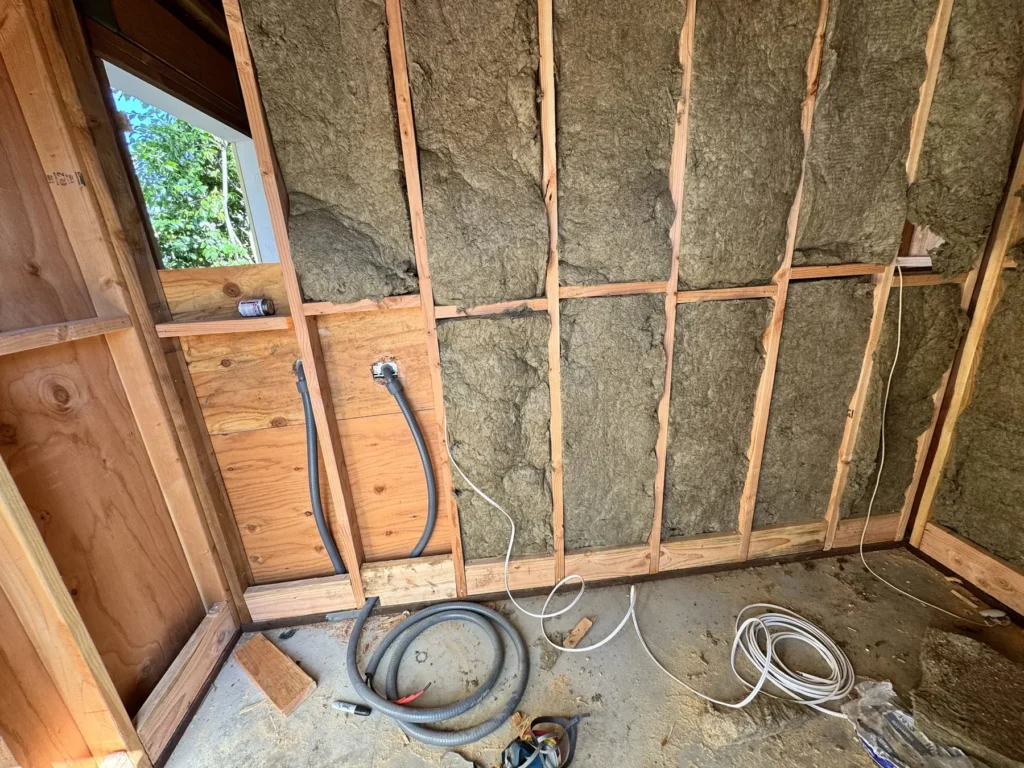
A shed with electricity in Orange County needs a permit, even at 120 square feet or less. The size exemption covers the building, and the wiring needs its own approval. We run a dedicated circuit from your main panel or a subpanel, usually trenched underground, and pull the permit under CSLB #1087479.
By Bedrock Sheds | CSLB #1087479 | October 22, 2026
Want the number for your yard? Call (949) 688-2674 and we’ll give you a real range the same day.
Power is what turns a shed from a box you store things in into a room you use. An office needs outlets. A gym wants a fan or a mini-split. A sauna can’t run without it. It’s also the point where the permit question stops being simple.
Does a shed with electricity need a permit in Orange County?
Yes. Wiring a shed takes a permit in Orange County even when the building is small enough to be exempt.
Here is what three cities publish, read from each city’s own page.
| City | Shed exemption | What it says about wiring |
|---|---|---|
| Irvine | One-story tool and storage sheds or playhouses up to 120 sq ft | Separate electrical and mechanical permits are still required for exempt items (permits not required page) |
| Huntington Beach | One-story tool and storage sheds, playhouses and similar up to 120 sq ft | Separate electrical permits required for exempt items (work exempt from permit form) |
| Anaheim | One-story tool or storage sheds and similar up to 120 sq ft | Adding outlets, lights or switches is listed as work that needs a permit (B804 handout) |
The pattern holds across all three. The size rule decides whether the building needs a permit. Wiring gets permitted on its own terms. Irvine puts it plainly: “separate plumbing, electrical and mechanical permits will be required.” For any other city, we look up the rule before we quote. What six cities publish about the building itself is in our Orange County shed permit guide.
How do you run power to a backyard shed?
We run a dedicated circuit to the shed, fed from your main panel or a subpanel, and on almost every job we trench it.
Dedicated means the shed has its own circuit and isn’t sharing one with a bedroom or the garage. Trenched means the wire runs in conduit underground from the house to the building. You can run power other ways, but a buried run disappears once the dirt goes back, and it’s what we recommend for how the yard looks afterward.
Here is the order it happens in:
- Site visit. We open your panel, measure the run from the house to where the building will sit, and note what’s in the way.
- Permit. We pull it under CSLB #1087479 before any wire goes in.
- Trench and conduit. The run goes in from the panel to the building.
- Rough-in. Boxes for lights and outlets go into the framing.
- Inspection. The rough-in is inspected before insulation or drywall covers it.
- Finish and final. Devices and fixtures go in after the walls are done, then the final inspection.
Main panel or subpanel: which one feeds the shed?
It depends on how much room your main panel has and how much the shed will draw.
If your main panel has an open space and the capacity to carry another circuit, the shed comes off it. If the main panel is full, or the house already has a subpanel closer to the yard, we feed from that. A desk lamp, a laptop and a fan draw very little. A mini-split or a sauna heater draws a lot more, and that’s the case where panel capacity decides the job. Older, smaller panels are the ones that sometimes need work first, and we’ll tell you at the site visit before anything is priced.
How much does it cost to add electricity to a shed?
We quote electrical per job and don’t publish a number for it, because three things move it too much: how far the trench runs, whether your panel can carry the circuit, and the permit.
A shed 20 feet from the house, fed from a panel with room to spare, is a short job. A shed at the back of a deep lot, past a pool and a concrete patio, fed from a full panel, is a much bigger one. Everything else on the build has a published price. The shell starts at $15,000 for an 8×10 and $18,000 for a 10×12, and the interior finish is priced by size in our backyard office cost guide. Power is the one line we price after we’ve seen your panel.
What changes once a shed has power?
Three things: the permit and inspections, the order the interior gets built in, and what the room can be used for.
The rough-in has to be inspected before the walls close, so if you want insulation and drywall, power gets planned at the start of the job. A mini-split adds a mechanical permit next to the electrical one, by the same city rules in the table above.
And the room can do more. An office gets real outlets instead of a power strip. A gym gets cooling. Every sauna we build is a powered building, because the heater is wired in, so every sauna goes through the permit too. How we build those is on our saunas page.
Can I skip the wiring?
If all you need is enough light to find the hose reel, skip the circuit.
A battery or solar light needs no wiring, and a shed used for storage at 120 square feet or less stays under the exemption. You save the trench, the permit and the electrical line on the quote. An extension cord run across the lawn from the garage is a different thing. That isn’t a power plan, and we won’t build around one.
If the room is a gym, see home gym shed cost. For a sauna, the circuit is included in the price, as our custom sauna cost guide explains.
Frequently Asked Questions
Can I add electricity to my shed later?
You can, and plenty of people do. It’s simpler during the build, because the rough-in goes into open framing and gets inspected before the walls close. Adding it after the drywall is up means working around a finished room. If power is a maybe, tell us at the site visit and we’ll plan the run with the build.
Does the wiring need its own permit, or is it part of a building permit?
It varies by city. Irvine and Huntington Beach describe separate electrical permits for a shed that is otherwise exempt. Anaheim’s handout describes a building permit that can cover building, electrical, mechanical and plumbing work together. Either way, we find out how your city handles it and pull what’s needed.
Who does the electrical work?
It’s part of our job. We schedule the electrical with the build and pull the permit under CSLB #1087479, so you’re dealing with one contractor from the site visit to the final inspection. You don’t have to find and coordinate a separate electrician.
Is electrical included in your published shed prices?
No. Every published price, from the shell to the Finished Interior package, is before power. We quote electrical after we’ve seen your panel and measured the run, and the permit is part of that quote.
The short version
Power always means a permit in Orange County, even on a small shed. We run a dedicated circuit, usually trenched, from your main panel or a subpanel, and price it after we’ve seen your panel.
If you’re working out what this looks like in your own yard, call (949) 688-2674 or email info@bedrocksheds.com and we’ll give you a real range the same day. Build once.
About Bedrock Sheds
Bedrock Sheds builds custom sheds and saunas on site in Orange County and San Diego County, California. Every building is framed and finished in your yard, with the same framing as the room you’re sitting in right now. No kits, no prefab. Brandon Radley Construction DBA Bedrock Sheds, CSLB #1087479, Class B General Building. Call (949) 688-2674, email info@bedrocksheds.com, or visit bedrocksheds.com.